
Understanding Degradants and Impurities
news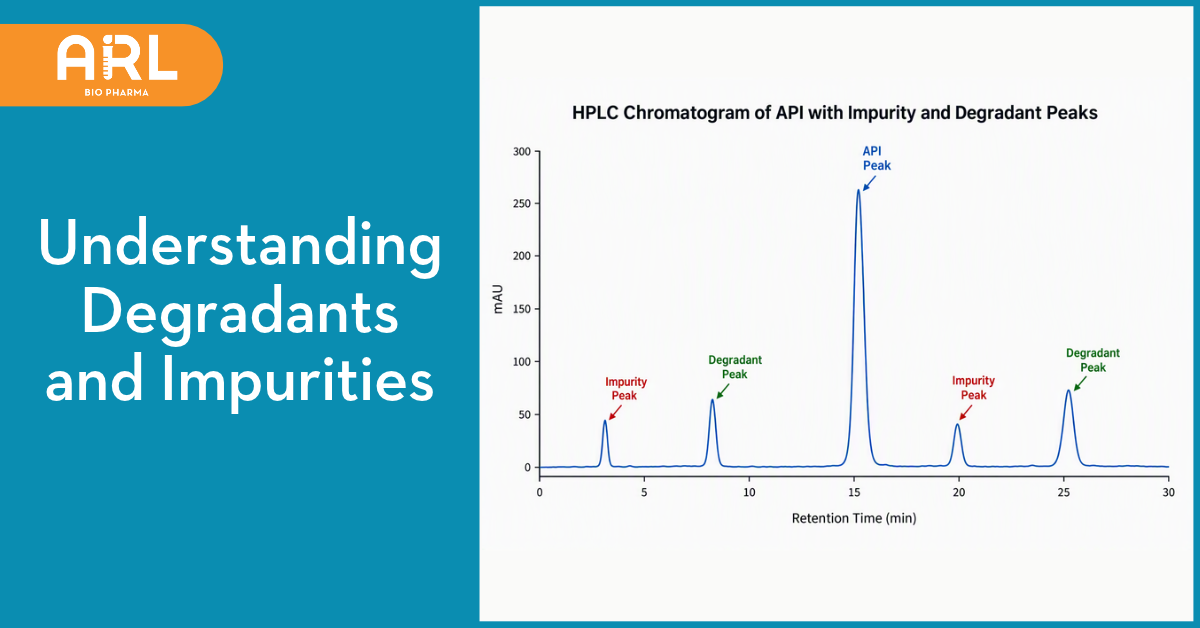
Ramkumar Varadharajan, Ph.D., ARL Bio Pharma R&D Associate Supervisor
In pharmaceutical compounding and drug development, product quality extends beyond verifying the identity and potency of an active pharmaceutical ingredient (API). Understanding the impurities present in a drug substance or drug product, as well as the degradation products that may form over time, is also important for evaluating product quality and safety.
What Are Degradation Products
Drug molecules can undergo chemical and physical changes during manufacturing, compounding, storage, or other stages of a product’s lifecycle. The compounds formed as a result of these changes are known as degradation products.
Common degradation pathways include:
- Hydrolysis: Breakdown caused by water or moisture, often influenced by pH.
- Oxidation: Reaction with oxygen or oxidizing agents.
- Photolysis: Degradation caused by exposure to light.
- Thermal degradation: Changes resulting from elevated temperatures.
- pH-related degradation: Instability under acidic or basic conditions.
Different drug molecules respond differently to environmental conditions. Some may be particularly susceptible to oxidation, while others may undergo hydrolysis or other chemical transformations more readily.
The resulting degradation products may have chemical structures and properties different from those of the original API. Depending on their identity and concentration, they may affect product quality, potency, or safety.
What Are Impurities
Impurities are unwanted chemicals present in a drug substance or drug product. Unlike degradants, they may originate from the materials and processes used to manufacture or compound a product, or they may form during storage.
Common sources of impurities include:
- Raw materials: Impurities already present in starting materials, excipients, or the API
- Manufacturing processes: Reactions by -products, intermediates, and residual processing chemicals
- Residual solvents: Solvents remaining from manufacturing or processing
- Packaging materials: Substances that may migrate from packaging into a product.
- Environmental contamination: Contaminants introduced during handling, preparation or storage.
Impurities are generally classified into three categories:
- Organic Impurities: These may arise during synthesis, processing, storage, or degradation of the active pharmaceutical ingredient.
- Inorganic Impurities: Examples include residual reagents, catalysts, heavy metals, salts, and filter aids.
- Residual Solvents: Trace amounts of solvents used during manufacturing or formulation that remain in the final product.
Understanding the source and behavior of impurities helps ensure patient safety and supports regulatory compliance.
Degradants and Impurities: What Is the Difference?
Although the terms are closely related, they are not interchangeable.
An impurity is defined by its presence in a material, while a degradant is defined by how it forms. Degradants are generally considered a subset of impurities.
For example, an organic by-product introduced during API synthesis is a process-related impurity. If the API subsequently reacts with oxygen during storage and forms a new compound, that compound is a degradation product.
For questions about degradants and impurities, contact ARL Bio Pharma at 800-393-1595 or info@arlok.com.
References
Waterman KC, Adami RC. Accelerated aging: Prediction of chemical stability of pharmaceuticals. International Journal of Pharmaceutics. 2005;293(1-2):101-125.
International Council for Harmonisation (ICH). Q1A(R2): Stability Testing of New Drug Substances and Products. Geneva, Switzerland; 2003.
International Council for Harmonisation (ICH). Q2(R2): Validation of Analytical Procedures. Geneva, Switzerland; 2023.
International Council for Harmonisation (ICH). Q3A(R2): Impurities in New Drug Substances. Geneva, Switzerland; 2006.
International Council for Harmonisation (ICH). Q3B(R2): Impurities in New Drug Products. Geneva, Switzerland; 2006.
United States Pharmacopeia (USP). 795 Pharmaceutical Compounding—Nonsterile Preparations. USP–NF.
United States Pharmacopeia (USP). 797 Pharmaceutical Compounding—Sterile Preparations. USP–NF.
Request a Quote