

Jessica Munson, Laboratory Director
Analytical methods such as HPLC, GC, dissolution, and microbiological testing often receive the most attention in pharmaceutical testing discussions. However, one of the simplest and most important quality assessments is appearance testing.
Appearance testing serves as a critical first indicator of product quality, consistency, and stability. Whether evaluating an active pharmaceutical ingredient (API), excipient, intermediate, or finished preparation, visual characteristics can provide valuable information regarding compounding performance, storage conditions, and potential degradation.
What is Appearance Testing?
Appearance testing is the evaluation of a material’s physical characteristics against predefined specifications. Depending on the preparation type, appearance testing may include assessment of:
- Color
- Clarity
- Presence of visible particles or foreign matter
- Physical form (powder, crystal, liquid, suspension, tablet, capsule, etc.)
- Texture or consistency
- Homogeneity
- Evidence of caking, agglomeration, or phase separation
While appearance testing may seem subjective when compared to instrumental analyses, it remains an essential component of pharmaceutical quality control and is often one of the first tests performed during release and stability programs.
Why Appearance Matters
Changes in appearance can indicate underlying quality concerns long before they are detected through more complex analytical methods. Examples include:
- Discoloration resulting from degradation or oxidation
- Increased turbidity indicating precipitation or contamination
- Crystal growth in solutions or suspensions
- Caking or clumping caused by moisture uptake
- Foreign particulate matter introduced during manufacturing or packaging
- Phase separation in emulsions or suspensions
In many cases, these observations prompt further investigation and may prevent potentially compromised material from progressing through the supply chain.
Developing Meaningful Appearance Specifications
One of the challenges associated with appearance testing is creating specifications that are both meaningful and practical.
Specifications that are too broad may fail to identify important changes in preparation quality, while overly restrictive specifications can lead to unnecessary investigations or rejection of acceptable material.
Examples of well-designed appearance specifications include:
- “White to off-white crystalline powder”
- “Clear, colorless solution free from visible particulate matter”
- “Slightly yellow viscous liquid”
- “Uniform white film-coated tablet with no visible defects”
Descriptions such as “acceptable appearance” or “normal appearance” should generally be avoided, as they are subjective and difficult to apply consistently across analysts, sites, and organizations.
Appearance Testing During Stability Studies
Appearance testing is particularly valuable during stability programs. Even subtle changes in color, clarity, or physical form can provide early indications of degradation pathways or packaging interactions.
Trending appearance observations alongside analytical data allow compounders to better understand a preparation’s behavior throughout its shelf life and may support future formulation or packaging improvements.
A Critical Component of Quality
Although appearance testing is often considered a simple test, it remains a fundamental element of pharmaceutical quality control and patient safety. A well-defined appearance specification, combined with consistent evaluation practices, provides an important safeguard against potential quality issues.
In pharmaceutical quality, the first indication that something has changed is simply what we can see. For more information on appearance testing, contact ARL Bio Pharma at info@arlok.com or 800-393-1595.
Bailey Rubin, Technical Sales Representative
Why Storage Conditions Matter
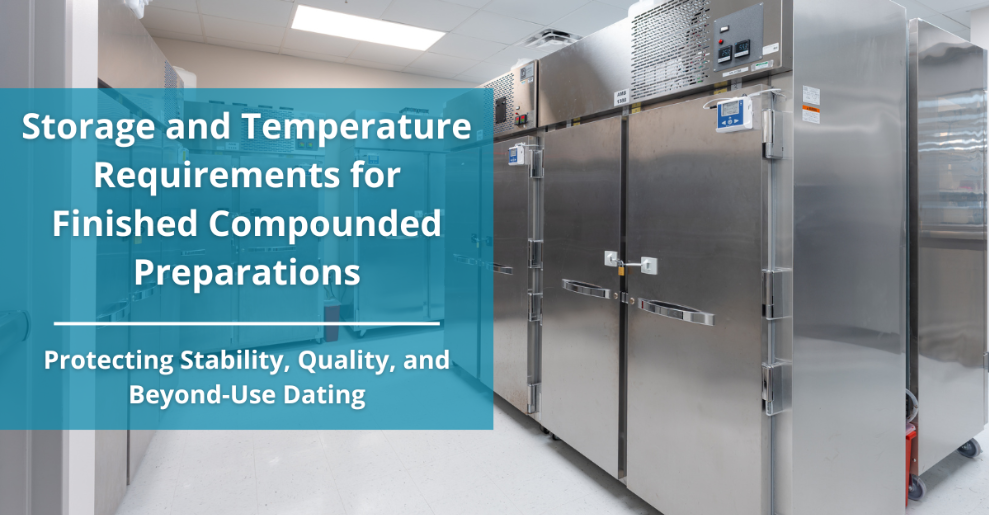
Concerns about the quality of compounded preparations do not end when they leave the cleanroom. From the time a preparation is compounded until it reaches the patient, it is exposed to environmental conditions that can directly impact its quality, stability, and assigned beyond-use date (BUD). Proper storage is a critical component of a pharmacy’s quality system. Maintaining appropriate storage conditions helps ensure compounded preparations remain safe, effective, and within specification throughout their assigned beyond-use date (BUD).
Regulatory Expectations for Finished Compounded Preparations
Regulatory guidance emphasizes the importance of maintaining appropriate storage conditions throughout a compounded preparation’s lifecycle. USP General Chapter 1079, Risk and Mitigation Strategies for the Storage and Transportation of Finished Drug Products, states that storage areas should consistently maintain the temperature ranges specified on the preparation’s labeling to preserve quality, efficacy, and beyond-use dating. These conditions should be established based on stability data and followed unless scientifically justified alternatives are supported. Stability testing evaluates how compounded preparations perform under defined environmental conditions and provides the scientific basis for establishing appropriate storage conditions and beyond-use dates.
USP recognizes that maintaining appropriate storage conditions involves more than simply setting a thermostat. Storage conditions can be affected by HVAC performance, airflow, facility traffic, seasonal variations, and other environmental factors. For these reasons, storage areas should be qualified through temperature mapping and supported by appropriate backup systems.
USP General Chapter 659, Packaging and Storage Requirements, outlines that storage conditions specified in a USP monograph should be followed unless the product labeling or prescribing information provides alternative storage instructions supported by stability data. When neither a USP monograph nor the product labeling specifies storage requirements, general protective measures should be implemented to minimize product degradation. Under these circumstances, preparations should be protected from temperatures above 40° C, moisture, freezing, and, when appropriate, light by using light-resistant containers during storage and transportation.
USP General Chapters 795 and 797 incorporate storage into the pharmacy’s overall quality management system by requiring compounded preparations to be stored under conditions that maintain their identity, strength, quality, and purity throughout the assigned beyond-use date (BUD), as supported by stability data. These chapters emphasize that storage conditions are an extension of the compounding process and require appropriate labeling, temperature control, documentation, and procedures for evaluating temperature excursions.
In addition, 21 CFR Part 205.50 requires facilities storing prescription drugs to provide appropriate environmental controls, including adequate lighting, ventilation, temperature and humidity control, sanitation, security, pest control, and designated quarantine areas. These general storage recommendations help protect product quality when more specific storage instructions are unavailable.
Key Storage Requirements for Finished Compounded Preparations
In summary, finished compounded preparations:
- Shall be stored according to the current edition of the compendium (USP/NF), stability data, and/or storage conditions specified on the preparation’s labeling.
- Should be maintained in qualified storage areas capable of consistently maintaining required temperature ranges using calibrated monitoring devices and documented procedures.
- Must be protected from temperatures above 40 °C, moisture, freezing, and, when appropriate, light throughout storage and transportation.
- May be evaluated following any temperature excursion to determine whether quality, stability, or the assigned beyond-use date may have been affected before dispensing or use.
- Should not be stored outside qualified storage conditions because of space limitations, equipment availability, or workflow convenience.
How Temperature Affects Stability
Temperature is one of the most significant contributors to chemical and physical instability in compounded preparations. Elevated temperatures can accelerate degradation reactions, reduce potency, and shorten the usable life of the preparation. Increased temperatures may also create additional challenges for moisture-sensitive formulations due to higher humidity. Conversely, freezing preparations not intended to be frozen may result in crystallization, precipitation, or other physical changes.
Monitoring Storage Conditions
Proper storage requires ongoing temperature monitoring. USP 1079 recommends calibrated devices capable of monitoring refrigerators, freezers, and controlled room temperature areas. Alarm systems should notify personnel when temperatures fall outside acceptable ranges so corrective action can be taken promptly.
If automated monitoring is unavailable, manual temperature logs may be used as part of a documented, risk-based monitoring program. Regardless of the monitoring method, temperature records should be reviewed routinely and retained as part of the pharmacy’s quality documentation.
Temperature excursions should be documented and evaluated using available stability data, excursion duration, temperatures reached, freeze-thaw history, and thermal cycling information when applicable. Decisions regarding compounded preparation disposition should always be supported by scientific evidence.
Supporting Stability and Quality Decisions
USP and other regulatory standards establish the framework for appropriate storage practices, while stability studies provide the scientific evidence needed to support storage recommendations and beyond-use dating. At ARL, we partner with 503A compounding pharmacies and 503B outsourcing facilities to generate stability and quality data, evaluate temperature-related concerns, and support confident storage decisions.
Contact ARL at info@arlok.com or call 1-800-393-1595 for more information to obtain the scientific data needed to support confident, compliant storage decisions.

Nicholas Pryor, ARL Bio Pharma Associate Lab Supervisor, Microbiology
Understanding USP 71 Method Suitability
Sterility testing by USP 71 is performed in conjunction with other sterility assurance procedures to help ensure that sterile preparations are free of microbial contamination and safe for patient use. Before sterility testing can be reliably performed on a product, a method suitability test must first be completed for the specific formulation.
What is USP 71 Method Suitability?
USP 71 focuses on sterility testing, and method suitability is a critical requirement within this framework. Method suitability demonstrates that the sterility test method used is capable of reliably detecting viable microorganisms in a specific pharmaceutical formulation.
In simple terms, method suitability answers the question:
“Can this sterility test reliably detect microorganisms in this specific product formulation?”
To verify this, known microorganisms are intentionally introduced into the product under controlled conditions. The test method must then successfully recover and support the growth of these microorganisms. If recovery cannot be demonstrated, the method is not considered suitable for that formulation.
Method suitability is formulation-specific because inhibitory properties can vary significantly between products. Active ingredients, inactive ingredients, preservatives, and vehicles may all interfere with microbial recovery.
Why Does Method Suitability Matter?
Pharmaceutical formulations can interfere with sterility testing in multiple ways. Without proper method suitability validation, there is a risk of false-negative sterility results, where a contaminated product may incorrectly appear sterile.
Common formulation challenges include:
- Antimicrobial preservatives that inhibit microbial growth
- Antibiotics or active ingredients with antimicrobial activity
- Viscous or oily formulations that trap microorganisms
- Suspensions or poorly soluble products that are difficult to filter
- Extreme pH or excipient interactions that suppress microbial recovery
Method suitability ensures that these formulation-specific challenges are identified and addressed before routine sterility testing is performed.
How is Method Suitability Demonstrated?
A sterility test method is selected based on a detailed evaluation of the product formulation and any applicable sub-formulations. The two primary sterility testing approaches described in USP 71 are closed-membrane filtration and direct inoculation.
Closed-Membrane Filtration
Closed-membrane filtration is the preferred sterility testing method because it separates the product from potential microbial contaminants, helping reduce or eliminate inhibitory effects from the formulation.
During the test:
- Product is passed through sterile closed-membrane filtration systems.
- Microorganisms are retained on the membrane filters while the product is directed to waste.
- The membranes are rinsed using validated rinse fluid to remove residual product inhibition.
- Following rinsing, growth media is aseptically added directly into the closed-membrane filtration systems, including:
- Fluid Thioglycollate Medium (FTM/FTG)
- Tryptic Soy Broth (TSB)
The closed systems containing the membrane filters and growth media are then incubated and monitored for evidence of microbial growth.
Direct Inoculation
Direct inoculation is typically used for products that cannot be filtered, such as certain oils, suspensions, or highly viscous formulations. In this method, the product is directly diluted into the growth media to reduce inhibitory effects. Additional neutralization strategies may also be required.
Compendial Test Microorganisms
USP 71 method suitability studies utilize six compendial challenge microorganisms that represent a range of bacterial and fungal microorganisms commonly associated with manufacturing environments and contamination risks.
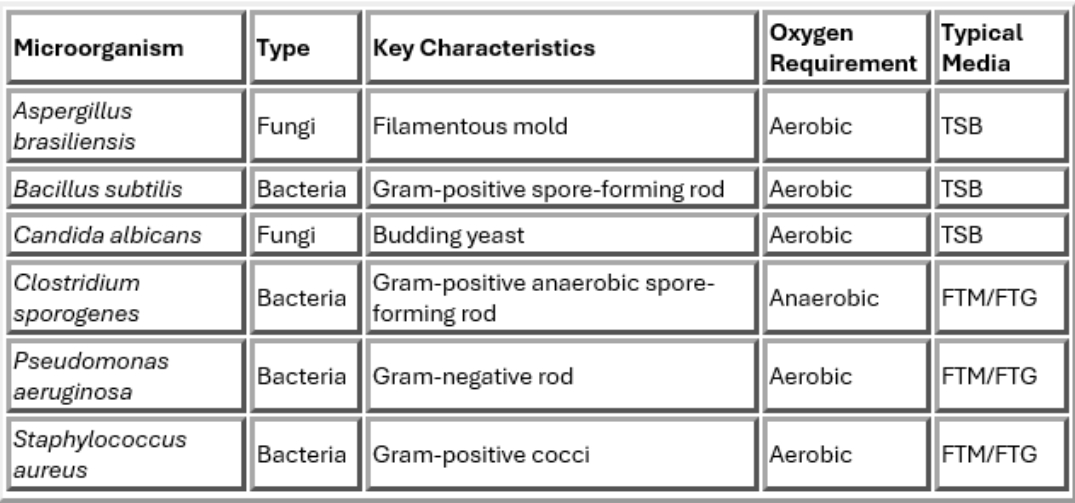
The method suitability test is performed by inoculating the selected media with less than 100 colony forming units (CFU), and confirming successful recovery and growth.
What Happens if Recovery Fails?
If all challenge microorganisms are not successfully recovered, the method must be modified and re-evaluated. Additional neutralization strategies may include:
- Increasing product dilution
- Adding validated neutralizers
- Incorporating pre-filtration dilution steps
- Performing additional membrane rinses
- Selecting alternative test methodologies
Increasingly conservative approaches may be required until all six challenge microorganisms can be adequately recovered.
Regulatory Importance
Demonstrating method suitability is a regulatory expectation and a critical component of sterility assurance programs. Regulatory agencies, including the FDA and international guidance documents such as ICH, expect manufacturers and testing laboratories to demonstrate that sterility testing methods are effective for each specific formulation.
Failure to establish method suitability may:
- Invalidate sterility test results
- Delay product release or approval
- Trigger regulatory observations or compliance concerns
- Increase patient safety risk
Importantly, the validated method remains applicable only as long as the formulation remains unchanged. Changes to active ingredients, preservative systems, vehicles, suppliers, concentrations, or sub-formulations may require method suitability to be repeated.
Key Takeaway
USP 71 method suitability is essential for:
- Ensuring sterility test accuracy
- Detecting formulation-specific inhibition
- Adapting sterility methods to challenging products
- Supporting regulatory compliance
- Protecting patient safety
By confirming that sterility testing methods can reliably recover viable microorganisms in a specific formulation, pharmaceutical manufacturers and testing laboratories can maintain confidence that sterility results are meaningful, accurate, and protective of patient health.
For more information on method suitability, contact ARL today and start the process today to obtain meaningful, accurate sterility results that prioritize patient health.